
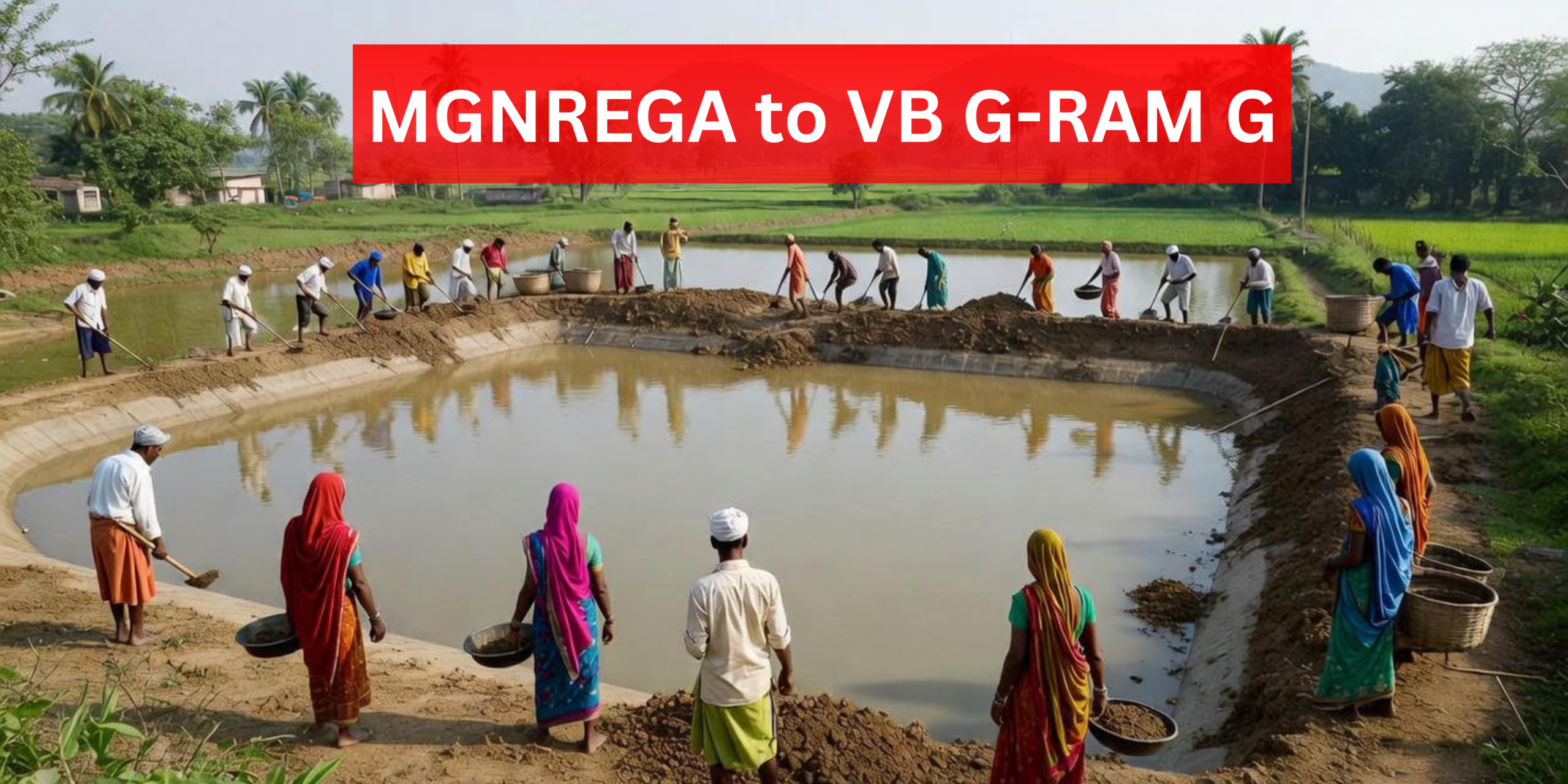

India’s rural employment landscape is undergoing a significant transition. The much discussed move from MGNREGA (Mahatma Gandhi National Rural Employment Guarantee Act) to VB G-RAM G Bill (Viksit Bharat Guarantee for Rozgar and Ajeevika through Modern Governance) signals a new approach to rural livelihoods, skill development and sustainable rural growth. While MGNREGA has been a backbone of rural employment for nearly two decades, the proposed VB G-RAM G Bill, 2025 aims to align employment generation with the broader vision of Viksit Bharat (Developed India).
Introduced during the Winter Session of Parliament, the Bill aims to modernise rural employment, expand guaranteed workdays and livelihood creation with the government’s long term vision of Viksit Bharat 2047. However, it has also sparked political debate and public concern due to its implications for funding, federal responsibilities and the dilution of a long standing legal entitlement.
Table of Contents
What is MGNREGA?
Enacted in 2005, the Mahatma Gandhi National Rural Employment Guarantee Act (MGNREGA) became one of the world’s largest social security and rural livelihood programmes. It was designed as a rights based law, not merely a welfare scheme.
Key Features of MGNREGA
- Legal right to work
Every rural household willing to do unskilled manual work was guaranteed at least 100 days of wage employment per year. - Decentralised implementation
Work was planned and executed through Gram Panchayats, strengthening grassroots democracy. - Timely wage payments
Wages were to be paid within 15 days, failing which workers were entitled to unemployment allowance. - Local asset creation
Projects focused on:- Water conservation
- Irrigation
- Land development
- Rural connectivity
For nearly two decades, MGNREGA acted as a lifeline during droughts, economic slowdowns and the COVID-19 pandemic, absorbing rural distress and providing income security.
Why the Shift from MGNREGA to VB G-RAM G?
The proposal to move from MGNREGA to VB G-RAM G is rooted in the changing needs of rural India.
Limitations of MGNREGA
- Predominantly unskilled work with limited long-term income growth
- Seasonal and temporary employment
- Rising fiscal burden on the government
- Limited integration with modern technology and market needs
As India moves towards a knowledge-driven and digitally enabled economy, policymakers argue that rural employment schemes must evolve beyond manual labour.
What is VB G-RAM G Bill, 2025?
The Viksit Bharat Guarantee for Rozgar and Ajeevika Mission (Gramin) Bill, 2025 proposes to repeal MGNREGA and replace it with a new legislative framework focused on both employment and livelihood creation.
1. Repeal of MGNREGA
The Bill formally repeals the MGNREGA Act, 2005, ending the existing legal framework and introducing a mission-based approach instead of a pure entitlement law.
2. Increased Guaranteed Workdays
One of the most notable changes is the increase in guaranteed employment days.
- MGNREGA: 100 days per rural household per year
- VB-G RAM G Bill: 125 days per rural household per year
This expansion is being presented as a progressive step to address rural underemployment and rising livelihood pressures.
3. Faster Wage Payment Timelines
The new Bill strengthens wage protection mechanisms:
- Wages must be paid:
- Within 7 days, or
- Within 15 days after completion of work
- If delayed, allowances will be payable, continuing the safeguard introduced under MGNREGA
This provision acknowledges that timely payments are critical for rural households dependent on daily wages.
Main Differences Between MGNREGA and VB G-RAM G
| Aspect | MGNREGA | VB G-RAM G |
|---|---|---|
| Nature of Work | Unskilled manual labor | Skill-based and diversified work |
| Employment Type | Short-term wage employment | Wage + self-employment |
| Focus | Employment guarantee | Livelihood and income guarantee |
| Technology Use | Limited | High (digital monitoring, skill mapping) |
| Long-Term Impact | Basic income support | Sustainable rural development |
This comparison shows that VB G-RAMG is designed as a next-generation rural development model.
How VB G-RAM G May Transform Rural Employment
1. Skill Development at the Core
VB G-RAMG emphasizes training in areas such as:
- Agriculture value chains
- Dairy and fisheries
- Rural manufacturing and crafts
- Digital and service-based jobs
This approach can help rural youth move beyond low-wage labor into higher-income opportunities.
2. Promotion of Self Employment
Unlike MGNREGS, which mainly focuses on wage work, VB G-RAMG encourages:
- Micro-enterprises
- SHGs (Self-Help Groups)
- Start-ups at the village level
This aligns with existing initiatives like Startup India and Digital India.
3. Better Use of Technology
VB G-RAMG is expected to rely heavily on:
- Digital job matching
- Online skill certification
- Direct Benefit Transfer (DBT) systems
- Real-time monitoring of outcomes
This could reduce leakages and improve transparency.
Transparency and Technology Measures
To improve governance and reduce leakages, the Bill introduces enhanced transparency tools:
- Biometric attendance
- Geotagging of worksites
- Digital monitoring of progress and payments
While these tools aim to improve accountability, critics argue they may exclude vulnerable workers lacking access to technology or facing biometric authentication issues.
Funding Pattern
One of the most controversial changes is the revised Centre State funding structure.
Proposed Cost Sharing Formula
| Region | Centre Share | State Share |
|---|---|---|
| Most States | 60% | 40% |
| North-Eastern & Himalayan States | 90% | 10% |
| Union Territories | 100% | 0% |
How This Differs From MGNREGA
- Under MGNREGA, wages were largely funded 100% by the Centre
- The new model shifts greater fiscal responsibility to states
Opposition parties argue this may strain state finances, especially for poorer states with high rural dependency.
Benefits of VB G-RAM G
1. Economic Empowerment
By focusing on livelihoods instead of temporary employment, VB G-RAMG can help rural families achieve financial independence.
2. Reduced Migration
Better local job opportunities may reduce distress migration to cities.
3. Alignment with Viksit Bharat Vision
VB G-RAMG fits into India’s long-term goal of becoming a developed nation by ensuring inclusive growth.
Comparison Between MGNREGA and VB-G RAM G Bill, 2025
| Feature | MGNREGA (2005) | VB G-RAM G Bill, 2025 |
|---|---|---|
| Legal Status | Statutory, rights based Act of Parliament | New legislative framework with mission oriented view |
| Objective | Provide wage employment as a legal right | Provide employment and sustainable rural development |
| Guaranteed Workdays | 100 days per rural household per year | 125 days per rural household per year |
| Nature of Guarantee | Legal right to demand work | Guaranteed employment under a structured mission |
| Implementation Agency | Gram Panchayats (decentralised) | Gram Panchayats with digital monitoring |
| Categories of Work | Broad, unclassified public works | Four focused categories: 1. Water Security 2. Rural Infrastructure 3. Livelihood Infrastructure 4. Disaster Resilience |
| Agricultural Season Consideration | No explicit restriction | Work avoided during peak sowing and harvesting seasons |
| Wage Payment Timeline | Within 15 days | Within 7 days or up to 15 days after work completion |
| Penalty for Delayed Wages | Unemployment allowance | Allowance payable for delayed payments |
| Use of Technology | Limited digital tools | 1. Biometric attendance 2. geotagging of worksites |
| Centre State Funding Pattern | Wages largely funded 100% by Centre | Centre State cost sharing (60:40 for most states) |
| Funding for NE & Himalayan States | Higher central support | 90% Centre, 10% State |
| Union Territories Funding | 100% Centre | 100% Centre |
| Annual Budget (Estimated) | Variable year to year | Around ₹1.51 lakh crore |
| Symbolic Association | Named after Mahatma Gandhi | Renamed under Viksit Bharat |
Concerns & Challenges
Despite its promise, the shift from MGNREGA to VB G-RAM G also raises concerns.
1. Job Security for the Poor
MGNREGA provides a legal guarantee of work. Any new framework must ensure that the poorest households are not excluded.
2. Implementation Capacity
Skill training, digital systems, and entrepreneurship support require strong institutional capacity at the grassroots level.
3. Transition Risks
A sudden replacement without adequate safeguards could disrupt income support for millions who depend on MGNREGA.
What Should Be Done for a Smooth Transition?
For VB G-RAM G to succeed, policymakers must:
- Ensure no dilution of employment security
- Phase the transition gradually
- Provide strong skill and hand-holding support
- Maintain transparency and accountability
A hybrid approach, where MGNREGA principles are integrated into VB G-RAM G, could be an effective solution.
Government’s Rationale Behind the New Bill
The government has officially justified the Bill on several grounds:
- Modernisation of rural employment laws
- Alignment with Viksit Bharat 2047
- Transition from short term wage relief to sustainable livelihood creation
- Better targeting, asset quality and disaster preparedness
According to the government, the new framework is not a dilution but an evolution of rural employment policy.
Conclusion
The transition from MGNREGA to VB G-RAM G represents a dynamic shift in thinking from survival based employment to growth oriented livelihoods. While MGNREGA will always be remembered for providing a safety net to rural India, VB G-RAM G has the potential to create a more skilled and economically strong rural population.
Frequently Asked Question (FAQ)
Yes, the new Bill proposes to repeal MGNREGA and replace it with VB G-RAM G.
The Bill guarantees 125 days of employment per rural household per year.
The Bill provides safeguards, but the shift from a rights-based Act to a mission framework may change the nature of legal entitlements.
Funding will be shared between Centre and States, unlike MGNREGA’s largely central funding model.
VB G-RAM G aligns with the Viksit Bharat vision by focusing on inclusive growth, productivity, skill development and economic self reliance in rural India.
By creating sustainable livelihood opportunities within villages, VB G-RAM G may help reduce distress migration to urban areas.